- Flux
- FLUX.1-schnell
- FLUX.1-dev
- LoRA training
- AI-Toolkit
- Licensing
- Commercial use
Flux Schnell vs Flux Dev LoRA Training: Settings and License Guide
Can you train a LoRA on FLUX.1-schnell? How it differs from FLUX.1-dev, the training adapter you need, sample settings, and what each license allows.
Can You Train a LoRA on FLUX.1-schnell?
Yes. FLUX.1-schnell and FLUX.1-dev are the same size and share the same architecture, so the same LoRA layers can be trained on either. The difference is how each model was distilled. Dev is guidance-distilled and still samples at 20 to 30 steps. Schnell is step-distilled so it can draw an image in 1 to 4 steps.
That step distillation is fragile. Train schnell directly with ordinary settings and every update erodes the shortcut it learned, so samples turn soft, noisy or washed out after a few hundred steps. The fix is a training adapter that absorbs the damage during training and is switched off for sampling and inference.
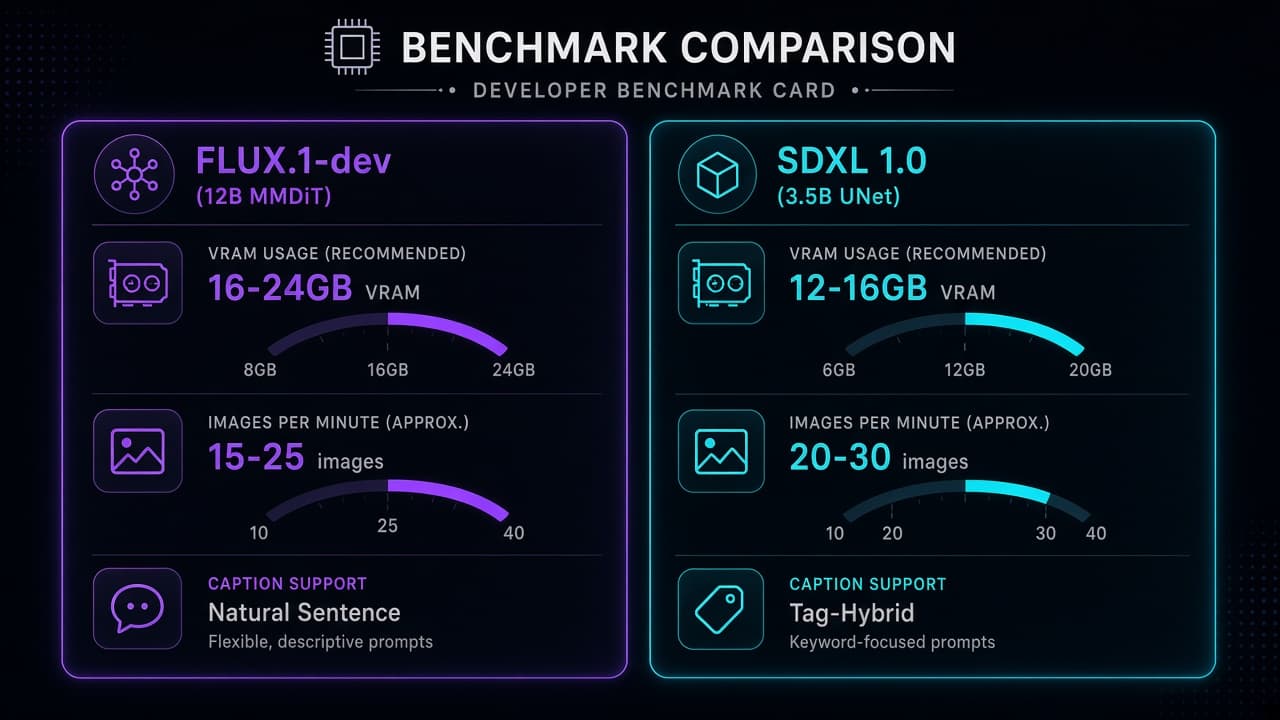
If you have not chosen between Flux and SDXL yet, start with our Flux vs SDXL LoRA comparison. This guide assumes you are on Flux and deciding between its two open variants.
FLUX.1-dev vs FLUX.1-schnell for LoRA Training
The table compares the two bases on the points that change your training run and what you can do with the result.
| Factor | FLUX.1-dev | FLUX.1-schnell |
|---|---|---|
| Distillation | Guidance-distilled | Step-distilled (timestep) |
| Typical sample steps | 20 to 30 | 1 to 4 |
| Guidance at sampling | About 3.5 | 1 (no guidance) |
| Extra training requirement | None | Schnell training adapter (assistant LoRA) |
| License | FLUX.1 dev Non-Commercial License | Apache 2.0 |
| License of a LoRA you train | Inherits non-commercial terms | Yours to license as you choose |
| Detail and prompt adherence | Higher | Slightly lower, faster |
| Community LoRA ecosystem | Very large | Small |
| Dev LoRA used on schnell | Native | Often weaker or off-style |
Same dataset works for both
How to Train a Schnell LoRA in Ostris AI-Toolkit
Ostris AI-Toolkit ships an example config for schnell. It points the model at FLUX.1-schnell and loads ostris/FLUX.1-schnell-training-adapter as an assistant LoRA. The adapter is active while training and disabled while sampling, and you do not need it after the LoRA is finished.
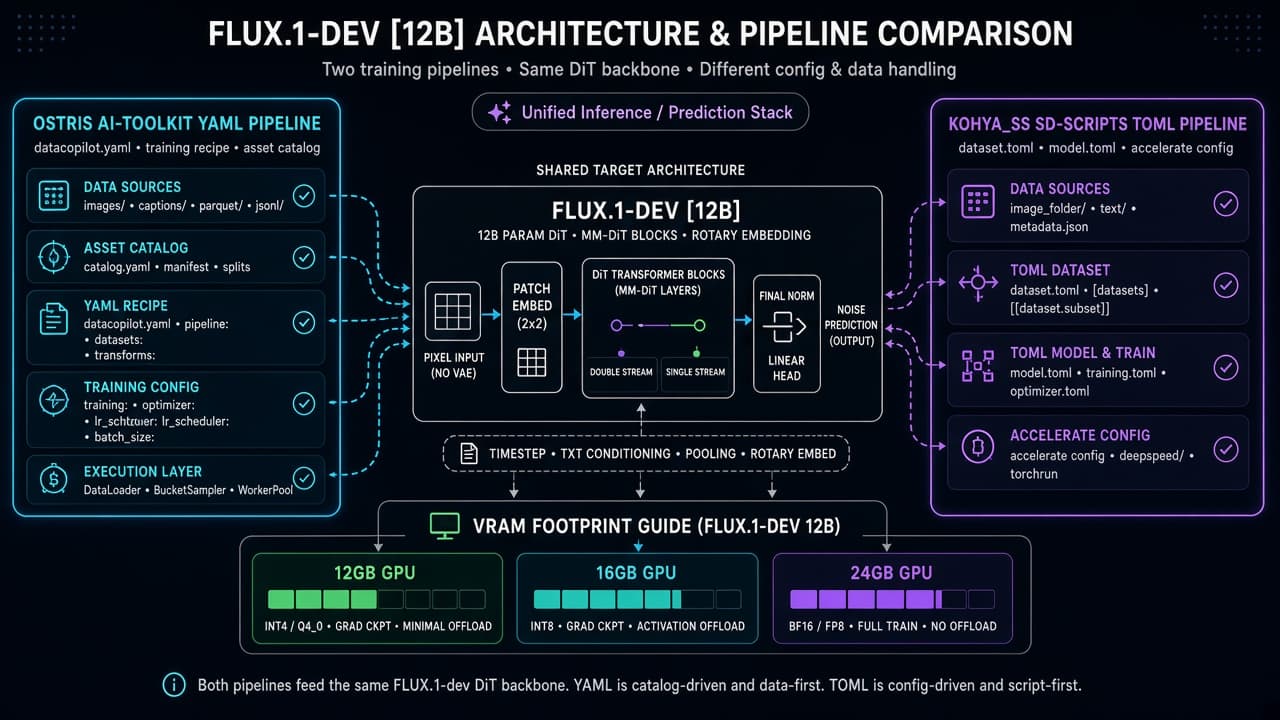
Everything else looks like a normal Flux run: rank 16, AdamW8bit, a learning rate of 1e-4, about 2000 steps, 8-bit quantization to fit 24 GB, and multi-resolution buckets at 512, 768 and 1024. For why those numbers work, see our LoRA learning rate guide and rank vs alpha explained. For trainer choice, read AI-Toolkit vs Kohya_ss for Flux.
model:
  name_or_path: "black-forest-labs/FLUX.1-schnell"
  assistant_lora_path: "ostris/FLUX.1-schnell-training-adapter"
  is_flux: true
  quantize: true
network:
  type: "lora"
  linear: 16
  linear_alpha: 16
train:
  steps: 2000
  optimizer: "adamw8bit"
  lr: 1e-4
  noise_scheduler: "flowmatch"
sample:
  guidance_scale: 1
sample_steps: 4- 01
Copy the schnell example
Start from train_lora_flux_schnell_24gb.yaml rather than the dev config. - 02
Keep the assistant adapter
Leave assistant_lora_path set, it is required for schnell training. - 03
Fix the sampler
Use guidance_scale 1 and 1 to 4 sample steps so previews reflect real schnell output. - 04
Train and compare checkpoints
Save every 250 steps and pick the last checkpoint before identity or style starts to overcook.
Licensing: Which LoRA Can You Use Commercially?
This is the main reason people train on schnell. FLUX.1-schnell is released under Apache 2.0, and so is the Ostris training adapter, so a LoRA trained on schnell can be licensed however you want, including for commercial products.
FLUX.1-dev uses the FLUX.1 dev Non-Commercial License. The license counts fine-tuned versions as Derivatives, so a dev LoRA carries the same non-commercial terms. Generated images are not Derivatives, but running dev or a dev LoRA for revenue, in production, or for users is outside the non-commercial grant. Black Forest Labs sells a commercial dev license for that case.
Mixing does not clean a license. A dev LoRA loaded on schnell is still a dev Derivative. If commercial rights matter, train on schnell from the start, or buy the dev license. This is a practical summary, not legal advice, so read the license text for your use case.
When to Train on Schnell and When to Stay on Dev
Pick the base by where the LoRA will run and who will pay for its output, then by quality.
| Situation | Recommended base | Why |
|---|---|---|
| Commercial app or client work without a BFL license | FLUX.1-schnell | Apache 2.0 base and adapter |
| Personal, hobby or research LoRA | FLUX.1-dev | Best detail and ecosystem |
| Real-time or high-volume generation | FLUX.1-schnell | 1 to 4 step inference |
| Sharing a LoRA on Civitai for most users | FLUX.1-dev | Most Flux users run dev |
| Production use with a BFL commercial license | FLUX.1-dev | Highest quality, license covers use |
Your dataset matters more than the base
Common Schnell LoRA Problems and Fixes
Most schnell failures come from treating it like dev. These are the patterns to check first.
| Symptom | Likely cause | Fix |
|---|---|---|
| Samples get blurry or noisy after a few hundred steps | Trained without the adapter | Add the schnell training adapter and restart |
| Previews look burned or oversaturated | Sampling with dev settings | Use guidance 1 and 1 to 4 steps |
| Dev LoRA looks weak on schnell | LoRA learned on the other base | Retrain the same dataset on schnell |
| Identity locks in early, then overcooks | Too many steps for the dataset | Pick an earlier checkpoint or lower steps |
Build One Dataset for Both Bases
Because the dataset is identical, you can train dev for testing and schnell for production from the same folder. Aim for 15 to 30 varied images with captions, as covered in our Flux LoRA dataset requirements.
The LoRA Dataset studio turns one reference into a consistent multi-angle set with captions ready for AI-Toolkit or Kohya, so you can run both bases and keep the one that fits your license and quality needs.
Frequently asked questions
Can you train a LoRA on FLUX.1-schnell?
Yes. Use a trainer that supports the schnell training adapter, such as Ostris AI-Toolkit, so step distillation is not destroyed. Sample at guidance 1 with 1 to 4 steps.
Do Flux dev LoRAs work on Flux schnell?
They load because the architecture matches, but they often look weaker or off-style on schnell. For best results, retrain the same dataset directly on schnell.
Can I use a Flux dev LoRA commercially?
Not under the default license. A LoRA trained on FLUX.1-dev is a Derivative under the dev Non-Commercial License. Commercial use needs a Black Forest Labs license or a licensed provider.
Is FLUX.1-schnell free for commercial use?
Yes. FLUX.1-schnell is released under Apache 2.0, and the Ostris schnell training adapter is also Apache 2.0, so LoRAs trained on it can be licensed as you choose.
What settings should I use to sample a schnell LoRA?
Use guidance scale 1 and 1 to 4 steps, with the training adapter turned off. Dev settings such as guidance 3.5 and 25 steps produce misleading previews.